
A system is asked: Can this supplier be paid today?
It could spend more time reasoning. But first it needs the supplier’s identity, the invoice status, any payment holds, and the applicable policy version. If those facts are missing, another model pass cannot supply them reliably. The system needs to find and resolve the evidence.
This distinction is central to inference engineering. Here, more inference means additional model-side work at serving time: longer deliberation, extra samples, or more model and verifier calls. That work can help. But it is only one of several operations an AI system can perform.
The engineering question is not simply how much a model should think. It is which operation will reduce uncertainty enough to improve the decision—and whether that improvement justifies its cost.
More compute can help, when it is allocated well
Inference-time compute can improve performance on difficult tasks. But the return depends on the task and on how the extra computation is used.
In their ICLR 2025 study of mathematical reasoning, Snell and colleagues found that the effectiveness of test-time compute strategies varied with prompt difficulty. Their adaptive, compute-optimal strategy improved compute efficiency by more than four times over a best-of-N baseline in their experiments. That result supports selective allocation; it is not a general multiplier for production systems. (Snell et al., ICLR 2025)
Other research has examined the opposite case. A 2025 ICML study found that long reasoning models could generate redundant solution attempts on simpler problems, with limited contribution to accuracy or diversity. The authors reported reducing computational overhead while preserving performance across the benchmarks they tested. This does not mean short answers are always better. It shows why answer quality and computation should be evaluated together. (Chen et al., ICML 2025)
The practical conclusion is narrower than “reason less”: allocate reasoning according to the problem.
Find the uncertainty before choosing the operation
An AI system can be uncertain for different reasons. It may not have a required fact. A rule may be ambiguous. Two sources may conflict. A calculation may be exact but poorly suited to a language model. Each condition calls for a different response.
| Signal | Useful next operation |
|---|---|
| A required fact is missing | Retrieve it from an authoritative source, or ask for it |
| A calculation or rule is exact | Use deterministic code or a policy engine |
| Evidence conflicts or relationships are unclear | Resolve the sources, then reason over the relevant evidence |
| The task has consequential uncertainty | Apply independent checks or escalate for human review |
| The request is clear and low risk | Answer and stop |
This table is a design recommendation, not an experimentally validated routing policy. The system still needs evaluations on representative tasks to determine whether its choices work.
A useful sequence is to assemble a case before generating an answer: identify the entities involved, retrieve relevant sources, make constraints explicit, and preserve where each fact came from. Structured representations—such as typed records, ontologies, or knowledge graphs—can help make relationships and constraints explicit. They do not guarantee that the data is correct or complete; they make the system’s interpretation easier to inspect and test.
Only then should the system decide whether to use direct generation, deeper reasoning, additional samples, a verifier, a deterministic tool, or a human reviewer.
Treat inference as a sequence of choices
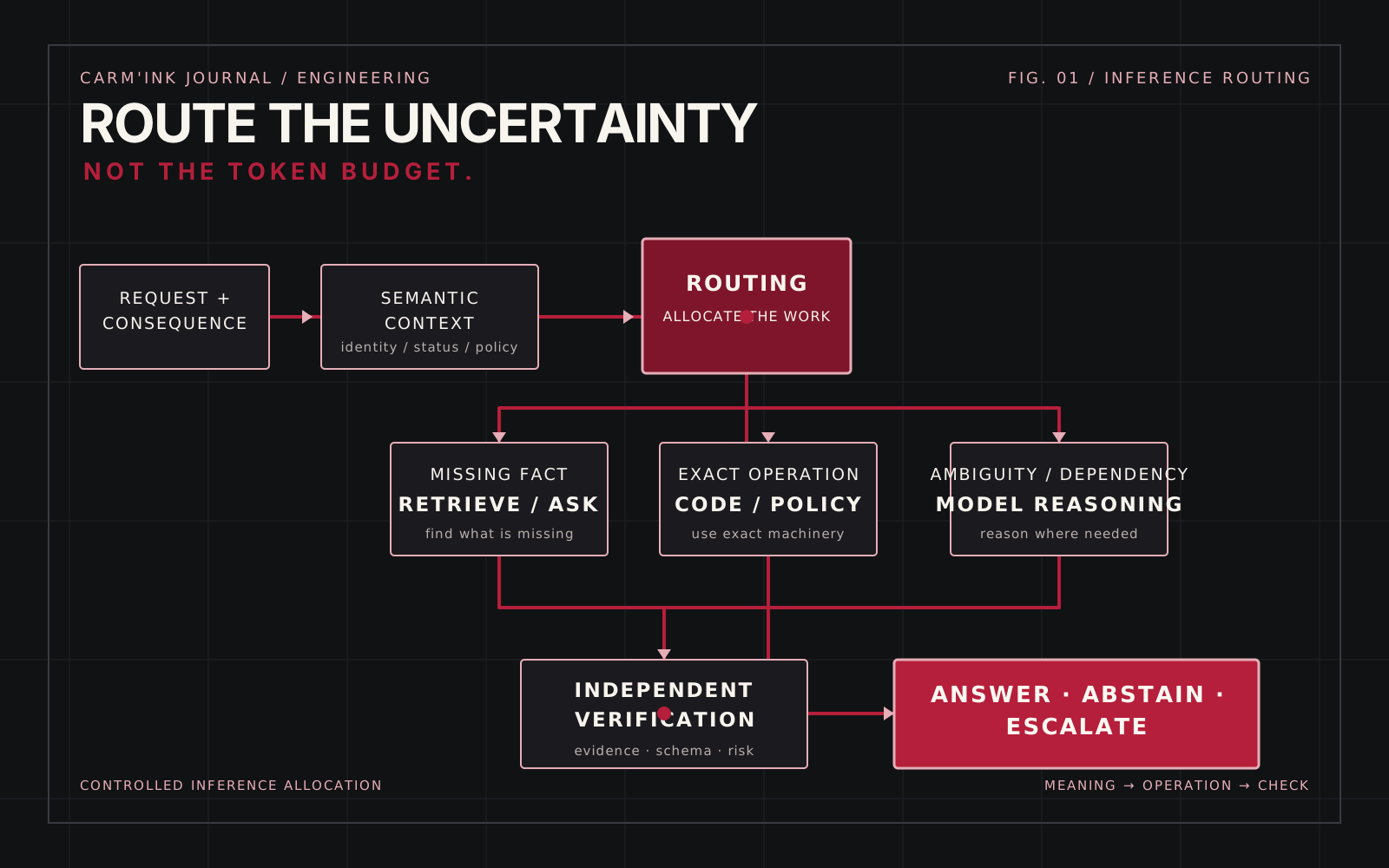
A practical inference system can be organized around five decisions:
- Characterize the request. Define the desired outcome, the constraints, and the consequences of an error.
- Assemble the evidence. Resolve identifiers and time-sensitive facts, retrieve authoritative sources, and keep provenance.
- Choose the next operation. Use code or rules for exact operations, retrieval for missing facts, and model reasoning where ambiguity or multi-step dependencies remain.
- Validate the result. Check schema, calculations, policy constraints, and support from the retrieved evidence. Treat a model’s stated confidence as useful only when it has been evaluated for that task.
- Stop, abstain, or escalate. Continue only when another operation is expected to improve the decision enough to justify its added cost and delay. If key evidence remains unavailable, say so or route the case for review.
This makes inference a control problem. The system should be able to explain why it spent more computation: a required constraint was unresolved, sources disagreed, a verifier failed, or the risk of an error justified an additional check. “Use more reasoning” is not a sufficient routing policy.
Evaluate the system, not just its token budget
Token count is a measure of activity, not a measure of correctness. A system can generate a long answer without finding missing evidence, resolving a contradiction, or checking a consequential action.
Evaluation should reflect the system’s purpose. Useful measures may include task success, evidence coverage, risk-weighted errors, abstention and escalation rates, latency percentiles, and the total cost of model calls, tools, and verification. Results should be examined across task difficulty and consequence, rather than summarized only as one overall score.
Compare fixed and adaptive compute policies on the same representative workload. Measure whether extra computation improves the outcome for the cases that receive it, whether the routing policy misses cases that need it, and whether the improvement justifies the latency and cost.
Better inference means choosing the right work
A stronger inference system does not maximize the number of reasoning tokens, model calls, or agents. It identifies what is unknown, chooses an operation suited to that uncertainty, checks whether the result is supported, and stops when further computation is unlikely to improve the decision.
Sometimes the right operation is deeper reasoning. Sometimes it is retrieval, a deterministic calculation, a clearer representation of the evidence, or a human decision.
That is the engineering thesis: better inference is not always more inference. It is the right computation, applied to the right uncertainty, with a result the system can verify.
References
- Snell, C., Lee, J., Xu, K., & Kumar, A. “Scaling LLM Test-Time Compute Optimally Can Be More Effective than Scaling Parameters for Reasoning.” ICLR 2025. Paper.
- Chen, X. et al. “Do NOT Think That Much for 2+3=? On the Overthinking of Long Reasoning Models.” Proceedings of the 42nd International Conference on Machine Learning, PMLR 267, 9487–9499, 2025. Paper.