
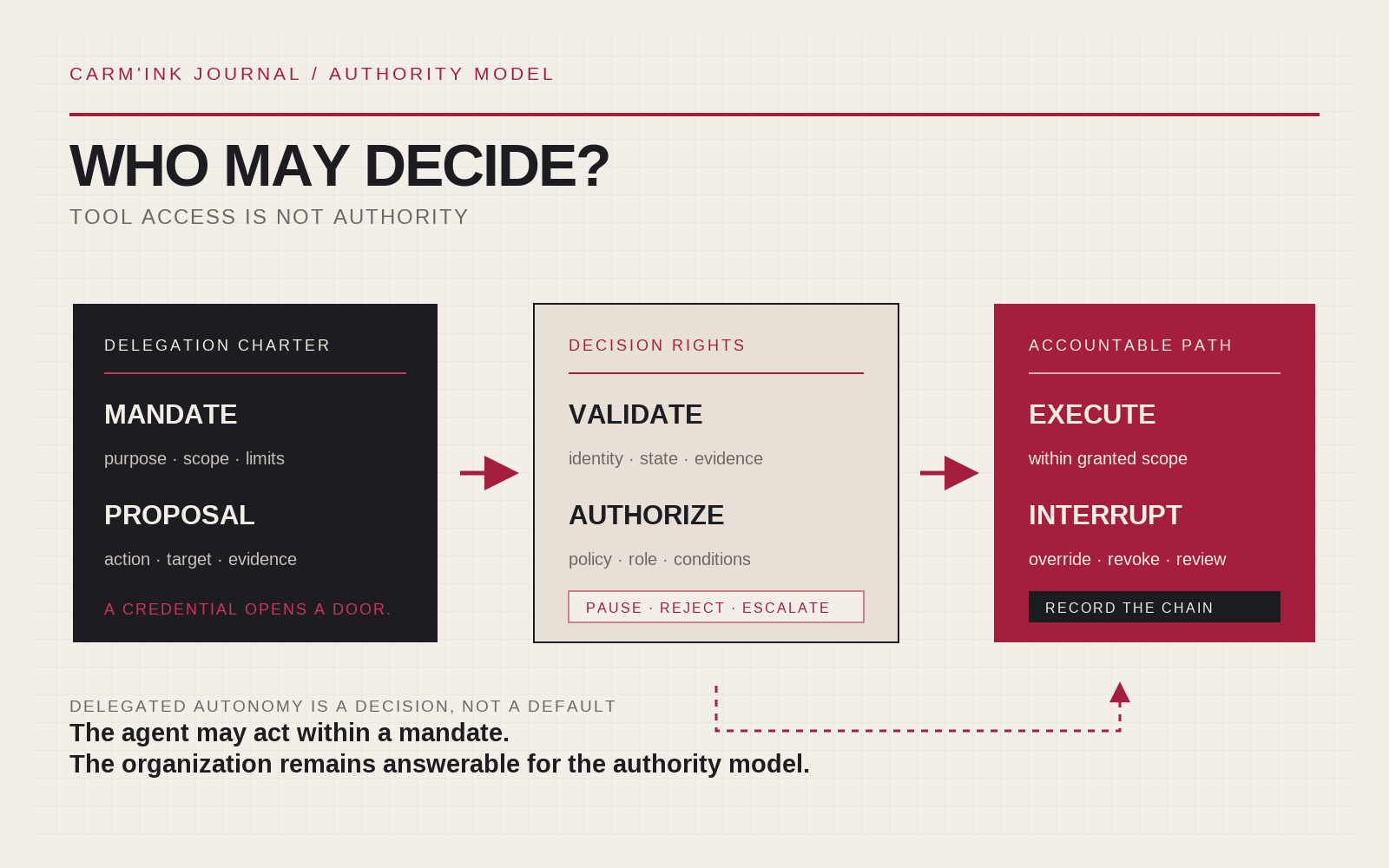
An agent may have permission to call a service and still lack authority to decide what the service should do. Production AI needs a clear account of who can propose, validate, authorize, interrupt and answer for each consequential action.
A tool permission answers a narrow question: may this identity perform this operation on this resource under the current policy? NIST’s description of attribute-based access control makes that question explicit: an access decision can depend on attributes of the subject and object, environmental conditions and policy rules. [1]
That is necessary infrastructure. It does not, by itself, settle who may interpret a policy, accept a risk, approve an exception or delegate judgment to an AI system.
Those are questions of authority.
An authority model names the principals who may exercise decision rights, the actions covered by those rights, the conditions that limit them, and the way those rights can be challenged, withdrawn and recorded. It connects an organization’s rules to the moment an agent tries to change something in the world.
A delegation charter
Treat the following clauses as a compact charter for agentic action. They are design questions to answer for each class of action—not a demand that a person approve every tool call.
Clause I — The mandate
Every agent should act within a mandate issued by an accountable person or organization. The mandate defines the purpose and scope of delegated work: which actions are covered, which resources may be affected, what conditions must hold, and where the delegation ends.
A credential can open a door. It cannot, by itself, explain why the agent is entitled to cross it.
A mandate may permit a system to perform routine actions automatically within tightly defined limits. It may reserve unusual, high-impact or out-of-scope decisions for a different authority. The important point is that the boundary is explicit. A general-purpose tool credential should not silently become a general-purpose decision right.
Clause II — The proposal
An agent can interpret context and propose what should happen next. Its proposal should identify the intended action and target, the purpose it serves, and the evidence or state on which it relies.
That proposal is not automatically an authorization.
A model’s confidence, fluency or ability to call a tool does not create a right to decide. If an organization delegates a class of decisions to an agent, that delegation should be stated as part of the system’s operating rules, with a defined scope and limits. Otherwise, the system risks hiding a policy decision inside an implementation detail.
Clause III — The validation
Before an action is authorized, the system should validate the relevant conditions. Depending on the action, those conditions might include the identity of the requester, the current state of the affected record, the applicability of a rule, the freshness of evidence or the match between the requested action and its stated purpose.
Validation does not always require a second human or a second AI model. A deterministic policy check, a trusted data source or an assigned reviewer may be the right control. The validation method should fit the action’s consequences, and it should be clear which part of the system performed it.
When evidence conflicts, a required condition is missing or the state has changed, the system needs a defined path to pause, reject or escalate. Treating an unresolved condition as permission is itself a decision—and one the authority model should make visible.
Clause IV — The authorization
The system should make clear where authority to proceed comes from. For some actions, a policy may pre-authorize execution when stated conditions are met. For others, the agent may prepare a proposal that a designated role must authorize.
Either way, authorization should apply to a discernible action. A reviewer should be able to tell what is being approved, what it will affect and what evidence supports it. A broad approval that survives a change in target, scope or relevant facts can outlast the decision it was meant to authorize.
NIST’s AI Risk Management Framework treats governance as a continuing part of AI risk management. It calls for clear roles and responsibilities, and places responsibility for AI-related risk decisions with organizational leadership. [2] In an agentic system, that responsibility needs to reach the operational boundary: who may approve which action, under what conditions, and with what ability to stop it?
Clause V — The execution
Execution should be constrained by the authorization that preceded it. The service that changes a record, sends a message or initiates a transaction should receive enough information to verify that the action remains within its authorized scope.
This is where the distinction between tool access and authority becomes concrete. An agent might be permitted to invoke a service for several purposes, while only some resulting actions are authorized. The permission to reach an endpoint should not collapse those decisions into one.
When the requested action falls outside the grant, the system should refuse or defer it. The action must not proceed merely because the technical route is available.
Clause VI — The interruption and override
An authority model needs a way to stop work, route uncertainty to the right person or role, and revoke a delegation when circumstances change. Escalation only works when the recipient has the authority and context to decide what happens next.
Overrides need their own boundaries. A valid override identifies who made it, what it covers, why it was used and how long it remains effective. If an override is an invisible bypass, the system cannot reliably distinguish an authorized exception from a failure of control.
An effective human review is therefore a decision right, not a notification. The reviewer needs enough information to understand the action and a real ability to approve, reject, amend or pause it.
Clause VII — The record
For each consequential action, the system should preserve the chain that made it possible: the principal who delegated authority, the agent or service that acted, the validation performed, the authorization applied and the resulting state change.
W3C’s PROV-O vocabulary models delegation between agents and describes the delegating agent as retaining some responsibility for the delegated work. [3] That is a useful design principle: delegation should make the chain of responsibility legible, rather than make responsibility disappear into an automated process.
A useful record does not merely say the agent acted. It makes it possible to ask: who or what authorized this action, under which mandate, using which evidence, and who can review or challenge the result?
Authority changes with its conditions
A grant of authority should be evaluated against the conditions that made it valid. If the target changes, the evidence becomes stale, the relevant state moves or the system’s mandate is withdrawn, the original authorization may no longer apply.
This gives the authority model a temporal dimension. Approval is not necessarily permanent; delegation is not necessarily transferable; and an earlier decision should not automatically cover a materially different action. The system needs to know when to revalidate, when to seek new authorization and when to do nothing.
This also explains why human oversight cannot be reduced to a single approval button. A person may define the mandate, review an exception, change a boundary, pause the workflow or revoke a delegation. Those rights belong at the points where they can shape what the system is allowed to do.
The measure of delegated autonomy
An authority model does not require every decision to be made by a human. It requires an organization to decide deliberately which decisions may be delegated, what checks apply and where responsibility remains.
The test is simple: can the system explain who authorized an action, the scope of that authority, the conditions it satisfied, and the person or organization able to review the decision?
If it cannot, the system may still have the technical ability to act. It has not made its authority clear.
References
- NIST, Guide to Attribute Based Access Control (ABAC): Definition and Considerations, Special Publication 800-162.
- Elham Tabassi, NIST, Artificial Intelligence Risk Management Framework (AI RMF 1.0), 2023.
- W3C, PROV-O: The PROV Ontology, W3C Recommendation.