
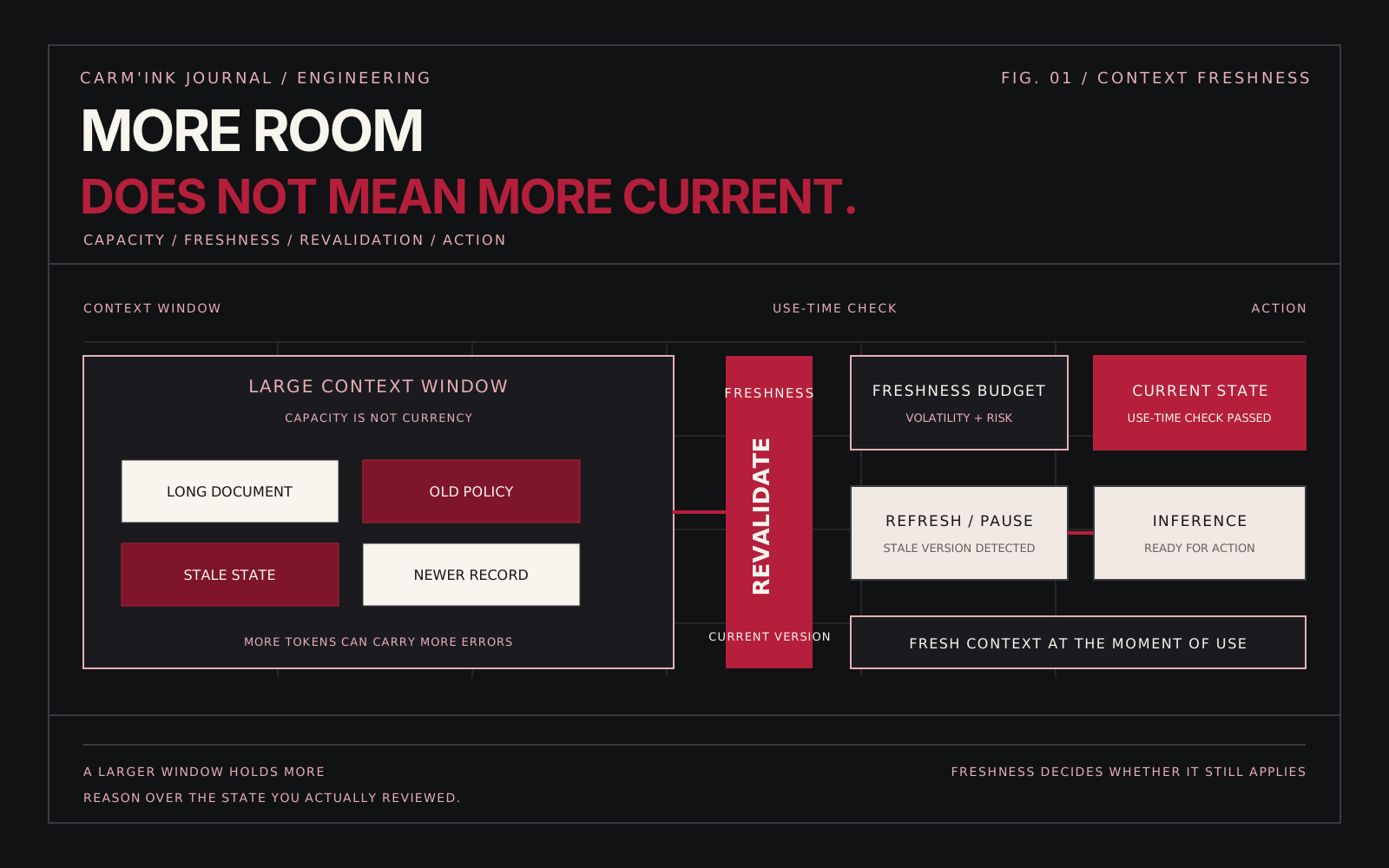
More tokens give a model room to read. Freshness determines whether what it reads still describes the situation it must reason about.
A larger window can hold more information.
It cannot make old information current.
That distinction matters when an AI system works with changing facts: a user’s permissions, an order’s status, a current policy, an account balance, or the state left by an earlier agent step.
A model reasons over the context supplied to it at inference time. If that context comes from stale indexes, cached answers, outdated session state, or yesterday’s tool results, increasing the token limit only gives the system more room to carry those errors forward.
For operational AI, context capacity and context freshness are separate engineering properties. The first concerns how much information can fit in one inference request. The second concerns whether the information remains valid for the task and the moment it is used.
Capacity does not establish currency
A larger context window can help with tasks that genuinely require broad source material: comparing long documents, examining a large codebase, or analyzing an extensive record. But capacity does not verify the current state of any source.
It also does not guarantee that the model will use every relevant item reliably. In a study of long-context models, Liu and colleagues found that performance on multi-document question answering and key-value retrieval could degrade when relevant evidence appeared in the middle of the input.[1] A window can therefore grow while the system still struggles to locate or prioritize the fact that matters.
Freshness solves a different problem. It asks whether the system’s working view is up to date enough for the decision it is being asked to make. A stale fact can be easy to find and still be wrong for the present task. A longer context can even preserve an obsolete value beside a newer one, leaving the model to infer which should prevail.
The engineering objective is not to maximize the window or to refresh everything as frequently as possible. It is to ensure that each fact is current enough for its intended use, and that the system can tell when it is not.
Freshness is a contract, not a timestamp
A timestamp is useful, but it is not a freshness policy. A document created recently may describe an old rule. A record from last month may still be the authoritative source for a historical event. The system needs to understand what a date means and whether the fact is valid for the task at hand.
A practical context record can distinguish:
| Time or version field | What it answers |
|---|---|
| Valid time | When the fact applies in the business or operational domain |
| Observed time | When a source or process recorded the fact |
| Source version | Which state or revision the source held |
| Sync or index time | When that version became available to retrieval |
| Context assembly time | When the system selected the fact for this inference |
| Use-time check | Whether the fact or version still holds before a consequential action |
This makes it possible to reason about lag rather than treating “newest timestamp” as synonymous with “correct.” Work on query age of information makes a related distinction: in pull-based systems, freshness can be judged at the time a query is made, rather than assuming new information is used continuously.[2] It also exposes a common failure: the retrieval system may be working exactly as configured while serving an outdated snapshot.
A freshness budget defines the maximum acceptable age or lag for a particular kind of information in a particular task. It should be set according to volatility and consequence, not as one global time-to-live for every context item.
| Information class | Example freshness requirement |
|---|---|
| Stable reference knowledge | Refresh when its governed version changes |
| Active policy | Resolve the version applicable to the decision or action date |
| Operational state | Read current state, or revalidate immediately before a side effect |
| Computed feature or aggregate | Carry its calculation time and the source-data watermark |
| Long-term memory | Retain history with dates; verify time-sensitive claims against current sources |
This allows a system to keep stable knowledge without repeatedly fetching it, while treating volatile state with the care it needs.
Freshness must follow the context through the whole loop
A production agent’s context is not only a set of retrieved documents. It may include working memory, conversation history, long-term memory, tool results, cached responses, retrieved records, and precomputed features.
Each component can become stale on a different schedule. A live database update does not automatically update a previously assembled prompt. A new indexed document does not remove a contradictory answer from session memory. A refreshed search result does not correct an earlier tool result that remains in the agent’s working state.
This is why freshness cannot be reduced to “refresh the RAG index.” It requires an explicit lifecycle for context: how changes enter the system, how cached and remembered information is invalidated or superseded, when volatile state is read, and what must be checked again before an action.
Redis’s June 2026 engineering article, “AI Context Windows: Why Context Quality Beats Context Size”, treats freshness as a design constraint and discusses measures such as timestamps, re-embedding when source documents change, and freshness targets for real-time decisions. Its July article, “Real-Time Context: Keeping Agent Inputs Fresh on Every Step”, extends the discussion across working memory, session state, long-term memory, tool results, retrieved documents, and machine-learning features.[3][4] The useful point is architectural: freshness concerns the context stack, not only the search index.
Revalidate when the decision depends on changing state
For a multi-step agent, a fact that was fresh at the start of a run may be stale by the time a later step depends on it. When one step changes a record, or another system can change it concurrently, earlier context must not silently remain authoritative.
The system should identify which facts are dependencies for a decision. Before a consequential action, it can re-read the relevant source or check that the source version still matches the one used to prepare the action. If the state has changed, the system should pause and reassemble context rather than act on the old snapshot.
This is a time-of-check-to-time-of-use problem as much as a retrieval problem. A system can retrieve a correct value and still act incorrectly if the underlying state changes between retrieval and execution. Version checks, conditional writes, or equivalent precondition checks can help ensure that an action is performed against the state it was reviewed for.
The same principle applies inside long-running inference workflows: refresh context between dependent steps when a new step relies on mutable facts. A live read at the beginning of the task does not guarantee a live view throughout the task.
Refresh selectively, with latency in view
Reading everything from its source before every model call may be fresh, but it can be slow, expensive, and unnecessary. Treating every datum as equally volatile creates avoidable load; treating nothing as volatile creates silent staleness.
A context system can combine several strategies:
- Event-driven updates or change-data capture for sources whose changes matter quickly.
- Time-bounded caching for information with a known acceptable age.
- Invalidation when source versions change.
- On-demand reads for facts needed at an action boundary.
- Snapshot and version metadata so an inference result can be traced to the context it used.
- Explicit “unknown” or “stale” states when the system cannot meet its freshness contract.
The system should measure whether these mechanisms meet the task’s requirements. Useful measures include source-to-context propagation lag, age of each time-sensitive fact at inference, stale-read rate, invalidation delay, revalidation failures, and the latency and cost of freshness checks.
A freshness target is meaningful only when attached to a use case. A search suggestion and an irreversible financial action should not inherit the same freshness budget by default.
The design rule
A larger context window is valuable when a task needs more relevant information at once. It is not a substitute for current data, consistent state, or revalidation.
CARM’INK’s engineering position is that context selection should be time-aware. The system should preserve when a fact was valid, when it was observed, which version it came from, and whether that version remains suitable for the current decision. Inference should not be expected to resolve conflicting timestamps by choosing whichever statement appears most often in the prompt.
For operational AI, the important question is not only how much context fits. It is whether the context still describes the world at the point where the system reasons and acts.
References
- Nelson F. Liu et al., “Lost in the Middle: How Language Models Use Long Contexts”, Transactions of the Association for Computational Linguistics, vol. 12, 2024, pp. 157–173.
- “Query Age of Information: Freshness in Pull-Based Communication”, IEEE Transactions on Communications, vol. 70, no. 3, 2022.
- Jim Allen Wallace, “AI Context Windows: Why Context Quality Beats Context Size”, Redis, 7 June 2026.
- Jeff Mills, “Real-Time Context: Keeping Agent Inputs Fresh on Every Step”, Redis, 15 July 2026.